Vape battery safety: the habits that matter
Ask around any British vaping forum and one point draws unanimous agreement: a cell deserves respect. That small cylinder holds a serious amount of energy, and the incidents that get reported almost always trace back to a careless habit rather than to bad luck. The good news is that vape battery safety rests on a short list of plain rules, passed from one vaper to the next and echoed by Trading Standards and government guidance. Here are the ones the community actually applies.
Vape battery safety comes down to a handful of rules
Vape battery safety is built from habits any vaper can adopt: carry cells in a rigid case, never use a cell with a torn wrap, charge with gear intended for the format and the chemistry, and follow the manufacturer’s own published figures rather than a number from a forum. None of this requires expertise, only repetition.
Applied properly, those rules remove the overwhelming majority of the risk attached to lithium cells. And none of them is inconvenient once it becomes automatic, no more than filling a tank or fitting a fresh coil is.
Carrying cells, the most ordinary risk of all
Most incidents are set up in a pocket, through nothing more than inattention. That is why carrying is the first item on the list rather than the last.
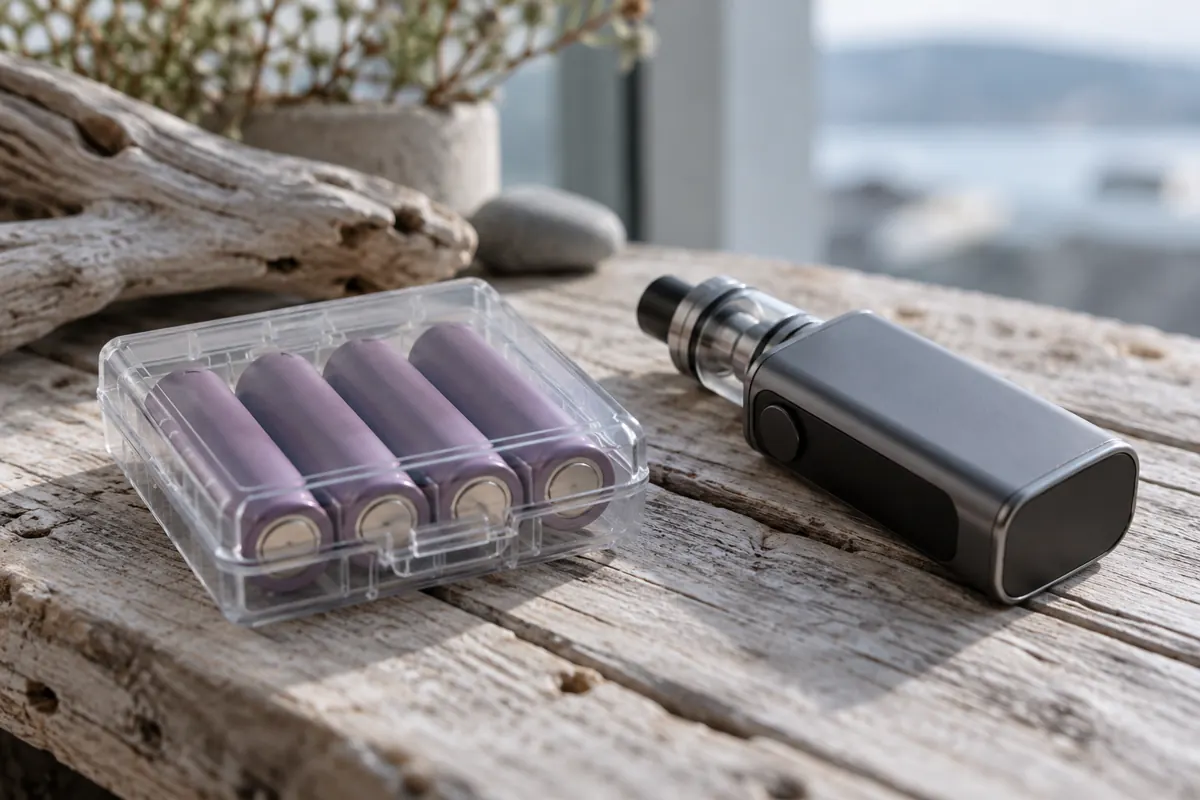
A cell travelling loose against keys, coins or another cell is exposed to an external short circuit. A metal object bridging the two poles can trigger a violent discharge and rapid heating, and it does not need a fault in the cell to happen. The fix is known to every experienced vaper: a dedicated rigid case, with each cell isolated in its own slot.
That habit applies to a single spare just as much as to a set of four. It is the cheapest object in the whole hobby and it neutralises the most frequent failure mode there is.
The wrap is a skin, not a decoration
The coloured sleeve on a cell has a job, and understanding it changes how you look at a scuffed cylinder. It is the difference between a cell in service and a cell in the recycling bin.
The wrap is the thin plastic layer that electrically insulates the body of the cell. The moment it is torn, nicked or lifting, even over a few millimetres, bare metal is exposed and a short circuit becomes possible at the first contact. A cell with a damaged wrap leaves the rotation immediately, to be rewrapped by someone properly equipped or recycled.
Checking the wrap when you charge or swap a cell is the single most useful inspection in vape battery safety, and it takes about two seconds.
Vape battery safety when charging
Charging concentrates a good share of the precautions worth taking, and the equipment matters as much as the routine.
A cell is charged with a unit designed for vaping cells, never with a phone mains block or an appliance charger built for something else, because the electrical behaviour is not the same. A suitable charger supervises the process and cuts off at the right moment, where unsuitable gear simply pushes. The criteria that separate them are set out in our vape battery charger guide.
British guidance is consistent on the rest of it. Do not charge overnight or while you are out of the house, check the device while it is charging, and unplug it once it is full. Charge on a hard surface that will not burn, at room temperature, and never leave cells sitting in a unit for days on end.
Temperature, current and matched pairs
Three more technical points close the list, and they carry as much weight as the obvious ones. They are the layer beginners tend to skip.
A lithium cell prefers a moderate temperature range. Cold reduces its performance temporarily, excessive heat degrades it permanently, and leaving a device on a car dashboard in summer is exactly the situation to avoid.
The second point is the discharge figure. Read the continuous discharge rating on the technical sheet published by the company that manufactured the cell, under the exact reference you own, and never off the wrap, which may belong to a rewrap and carry a number no manufacturer published. That reading is the whole method, and our 18650 battery guide walks through it in detail.
The third is pairing. On a dual cell mod, the community repeats one rule without exception: two identical cells, same reference, same age, same charge level, bought together, used together and recharged together. A mismatched pair loads the weaker cell while the stronger one still has reserve, and a marked pair that never gets split is the simplest way to hold that line.
Retiring a cell properly
A cell is not ordinary rubbish, and how it leaves service belongs squarely inside vape battery safety. It protects the household as much as the environment.
A cell that has swelled, that runs warm for no reason, that has lost its wrap or whose runtime has collapsed comes out of service and does not go back in. It goes to a battery recycling point, and those sit in most British supermarkets, larger shops and household waste sites. It does not go in a kerbside bin, where a damaged lithium cell is a genuine fire risk for the people who handle it.
While it waits for that trip, it is stored on its own, away from heat and away from anything metal. Ending a cell’s life cleanly is the last act of a routine that started when you bought it, and it is the one most people forget.
Frequently asked questions
How should cells be carried?
In a dedicated rigid case, each cell isolated from the others and from any metal object. It is the most effective precaution against external short circuits, which happen most often when a cell travels loose in a pocket alongside keys or coins.
What do I do if the wrap on my cell is torn?
Take it out of service straight away. The wrap insulates the metal body of the cell, and a tear exposes it to a short circuit. It should be rewrapped by someone properly equipped before any further use, or taken to a battery recycling point if it is old or otherwise damaged.
Can two different cells go in a dual cell mod?
No. A dual cell mod needs two identical cells: same reference, same age, same charge level. A mismatched pair creates an imbalance in charge and discharge that loads one cell abnormally. This is a constant rule on that kind of hardware, not a preference.
Is a swollen cell still usable?
No. Swelling indicates internal degradation and the cell is finished. It is not recharged and not reused. Store it on its own, away from heat, and take it to a battery recycling point at the first opportunity.
Is it dangerous to leave cells in sunlight or in a car?
Yes. Excessive heat degrades a lithium cell and takes it outside the range it was designed for. A device left on a dashboard or in a hot car should be avoided. Keep cells at room temperature, out of direct light and away from any heat source.
What the community keeps repeating about vape battery safety
Vape battery safety is not specialist knowledge reserved for the initiated. It lives in a few gestures every vaper passes on: the rigid case, the wrap inspection, a charger suited to the format, matched pairs kept together and a recycling point at the end.
Turn those into reflexes and you remove almost all of the risk without giving up anything at all. Read the manufacturer’s own sheet for your exact cell rather than a figure from a stranger, and when in doubt about a cell, retire it rather than argue with it. That shared culture of attention and mutual advice is what makes vape battery safety a community habit rather than a warning label, and it is the same instinct that runs through our 21700 vs 18650 comparison.
Editorial content for adult readers only. Vaping products usually contain nicotine, a substance that causes addiction. Not for sale to under-18s in the United Kingdom. This article is not a buying recommendation.